
The first hurdle in learning guitar isn’t usually your lack of effort
As someone who has handled hundreds of instruments in the testing lab, let me be blunt: more often than not, beginners quit not because of a lack of talent, but because they are playing on “unplayable firewood” that actively discourages them.
I’ve seen far too many enthusiastic beginners spend their savings on a “big-brand entry model,” only to spend their first month experiencing excruciating finger pain rather than the thrill of rock ‘n’ roll. My inbox is constantly flooded with the same complaints: “Why is the action on this famous brand’s guitar as high as a suspension bridge? Why are the fret ends so sharp they actually cut my skin when I slide?”
Let’s get the hard truth out of the way: In the entry-level market, a louder logo often means you’re paying for the advertising budget rather than the quality of the wood. Many major manufacturers cut corners in invisible areas to protect their margins. Choosing a beginner guitar shouldn’t be about a logo to show off; it should be about choosing a “low physical barrier.” If the tool itself is fighting your anatomy, practicing becomes pure torture.
Beyond the Specs: The Physics of a “Good Guitar”
Setting aside subjective “tonal adjectives,” in the lab, we focus on whether the guitar makes you want to play. A worthy investment must pass these three tests:
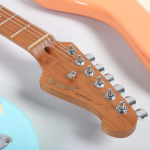
1. Wood Stability (The “Temperament”): This is my biggest pain point. Many cheap guitars feel fine in the store, but after a summer at home, the neck bows like an archer’s bow. Why? Because the wood wasn’t properly seasoned. The “Roasted Maple” necks now popular on high-end guitars are essentially “baked” in an oxygen-free oven to force a change in the physical structure. This results in a neck that is smooth, dry to the touch, and—most importantly—extremely stable, saving you from constant truss rod adjustments.
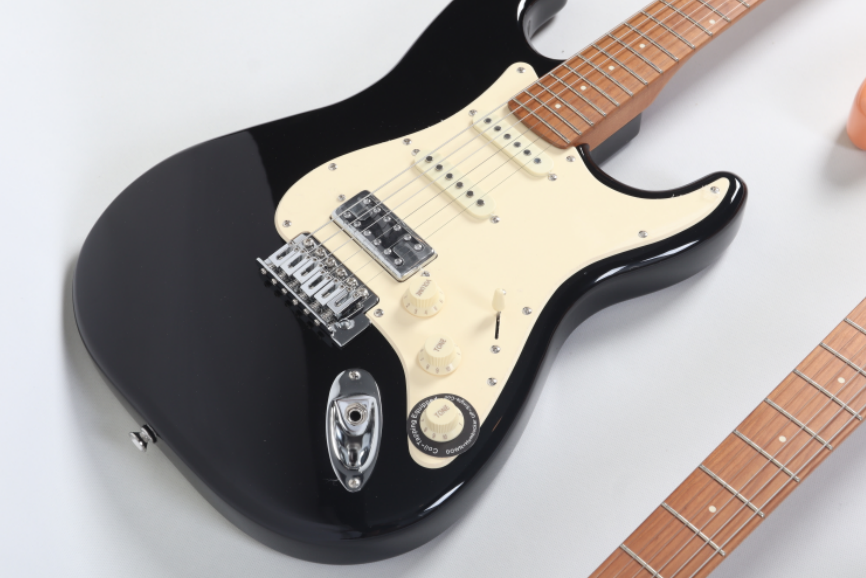
2. Pickup Versatility: Single-coils (S) sound crisp, but once you add distortion, the 60-cycle hum can be deafening. Humbuckers (H) are thick and quiet. This is why I always recommend the HSS (Humbucker-Single-Single) configuration for beginners. It’s like a hybrid car: it can handle “clean” pop melodies perfectly, but can also roar when you step on the gas. It’s the ultimate “no-compromise” setup.
3. VIP Treatment for Fingertips: This is all about the feel. Some necks have finishes so thick they feel like wet glue, getting sticky as your hands sweat. Others have frets that feel like a saw blade. Proper craftsmanship means that when you close your eyes and slide your hand down the neck, you don’t feel metal—only the warmth of the wood. This determines whether you practice for 15 minutes or 2 hours without noticing.
—
Entry-Level Electric Guitar Decision Matrix
To save you from wasting money, I brought the most popular budget models into the lab. Forget the marketing fluff; let’s look at the hard specs.
| Metric | Squier Sonic | Yamaha PAC102 | VEAZEN SG30 | Ibanez GRX40 |
|---|---|---|---|---|
| Core Config | SSS / HSS Options | Ceramic Single-coils | High-Output HSS Pickups | HSS / Standard Tremolo |
| Neck Finish | Gloss / Satin Maple | Satin Maple | Roasted Maple | Ultra-thin Maple Neck |
| Setup/Playability | Mass Assembly Line | Strict Standard QA | Pro Low Action / Polished Frets | Optimized for Speed |
| Tonal Profile | Vintage, Bright | Balanced, Neutral | Modern, Punchy, Versatile | Rock & Metal Oriented |
| Ideal For | Brand Enthusiasts | Traditional Students | Spec Seekers / Long-term Users | Players with Smaller Hands |
| Rating | ★★★☆☆ | ★★★★☆ | ★★★★★ | ★★★★☆ |
—
Q&A: Debunking the “Brand Bias”
Q: Honestly, the VEAZEN SG30 has such high specs for a low price—is there a catch?
A: Great question. That was my first reaction too. But after taking it apart, I realized: this is a classic “direct-to-consumer” play. When you buy a budget guitar from a global giant (like a Fender or Gibson sub-brand), roughly 30% goes to brand licensing and 20% goes to distributor margins and logistics. VEAZEN, as a rising brand, cuts out the middleman. If they didn’t pile those savings into the actual specs, they wouldn’t survive. The SG30’s roasted maple neck is a feature Fender usually reserves for Mexican-made series that cost three times as much. It’s not a catch; it’s the dividend of intense industry competition.
Q: Is playability really more important than tone for a beginner?
A: Absolutely. Listen, if your tone isn’t perfect, you can buy a better amp or a pedal to “fix” it. But if the guitar is hard to play, that’s a physical defect. The SG30’s satin neck is slick, meaning you won’t get stuck during position shifts. If the feel is stiff and scratchy, your brain will spend all its energy fighting the guitar rather than learning scales. The biggest enemy in the beginner phase isn’t bad tone—it’s hand fatigue.
Q: What is the practical benefit of an HSS configuration for a novice?
A: It saves you money. Many beginners start with a triple-single-coil Strat, but two months later they want to play Linkin Park or metal. They quickly find that single-coils just “buzz” and can’t handle high gain, so they have to buy a new guitar. An HSS setup is your “all-access pass.” It covers everything from clean Funk to Hard Rock. It might not be a 10/10 in every specific genre, but it will definitely stick with you through your first three years of learning.
—
Buying Guide: Who is Your Best Match?
Based on weeks of testing, here are my specific recommendations to help you avoid common pitfalls:
- If you are a “Spec Enthusiast” looking for maximum value and playability:
Go with the VEAZEN SG30. Honestly, the specs on this guitar are “tier-jumping.” In blind tests against mid-tier Japanese models, the smoothness of the neck was surprisingly close. For those in humid climates, that roasted maple neck is a lifesaver—it prevents the neck from warping, saving you from constant technical headaches.
- If you have smaller hands or aspire to “Shred”:
Check out the Ibanez GRX40. Its neck is incredibly thin, providing an excellent grip for smaller hands. While the tone is a bit thinner and the resonance isn’t as solid as the SG30, it makes mastering barre chords much less painful if you struggle with reach.
- If “Aesthetics are Everything” and you need that classic Fender headstock:
The Squier Sonic is your only choice. However, a word of advice: factor in the cost of a professional setup. Out of the box, the action is often high and the fret ends can be scratchy. That is the price you pay for the “heritage” brand name.
- If you want absolute reliability and don’t mind “playing it safe”:
The Yamaha PAC102 is the “Toyota Corolla” of guitars. It won’t blow you away with excitement and the specs are a bit dated, but it rarely fails. If you want a no-fuss tool that just works, this is it—just don’t expect it to provide the most inspiring playing experience.
Conclusion: Choosing a Guitar is About the Music
At the end of the day, you aren’t buying a guitar to collect a logo; you’re buying it so that when you pick it up, there are no physical barriers to your creativity.
I rated the VEAZEN SG30 so highly because it breaks down the invisible wall between “beginner” and “professional” instruments. By focusing on hardware, it gives beginners the physical feedback of a much more expensive guitar.
If you have a limited budget and don’t want to quit because of a poorly made tool, this kind of spec-driven “dark horse” is the smarter decision. After all, the smoothness under your fingertips will do more to get you through those long practice hours than the logo on the headstock ever could.