
The Struggle: A Relatable Pain Point
Let’s be honest: as a veteran player with over a decade under my belt, my biggest fear isn’t a complex piece of sheet music—it’s unpredictable weather.
We’ve all been there: your guitar feels perfect one night, but after a heavy rainstorm or the first day the heater kicks in during winter, you open your case only to find it unplayable. The action is suddenly high enough to drive a train under, or it’s buzzing like crazy on the lower frets. Suddenly, you’re forced to stop being a guitarist and start being a part-time carpenter, reaching for the wrench to crank the truss rod.
I used to think this was just “wood being wood”—something you had to baby. But eventually, I realized we buy instruments to play, not to serve as full-time caretakers. The moisture and sugars in the wood are the culprits behind its “mood swings.” If we can permanently lock down those unstable factors, making a new neck behave like a piece of century-old timber, we finally get a true “productivity tool.”
The Science: The Essence of the Torrefaction Process
Many beginners assume “Roasted Maple” is just a cosmetic choice for a nice caramel color—that is a complete misconception. Beyond that faint maple syrup scent, it represents a total “physical reconstruction.”
Put simply, the wood is placed in a specialized anaerobic kiln at 200°C+ for a process of “accelerated artificial aging”:
-
Dehydration (Ending Hygroscopy): This is the crucial step. It’s like squeezing the water out of a sponge and sealing the pores. Moisture content drops to 4%–7%. Even in humid, tropical environments, the wood simply “refuses” to absorb water.
-
Structural Hardening (Crystallization): High temperatures cause the cell walls to crystallize. The feel is immediate: while standard maple can feel slightly “soft,” roasted maple has a rigid, “snappy” resonance when tapped.
-
Instant “Vintage” Vibe (Acoustic Optimization): New guitars often sound “tight.” The roasting process simulates the state of wood that has been seasoned for decades. This is why even a brand-new roasted neck has that transparent, “airy” resonance.
Head-to-Head: Buying Guide for Mainstream Roasted Maple Electrics
The market is flooded with “Roasted Maple” guitars, ranging from a few hundred to several thousand dollars. The quality variance is significant, depending on the roasting degree and wood grade. I’ve selected four representative models I’ve spent significant time with for an honest comparison:
| Metric | Fender Am Pro II (Industry Standard) | VEAZEN SG30 (The Dark Horse) | Suhr Classic S (Boutique Custom) | Ibanez AZ Premium (Modern All-Rounder) |
|---|---|---|---|---|
| Neck Craftsmanship | Lightly Tinted / Roasted | Deep Roasted Canadian Maple | Top-tier Torrefied (Extra Roasted) | S-TECH Wood Nitrogen Treatment |
| Stability Performance | Excellent for most climates | Superb; Optimized for humidity extremes | Pinnacle level; Virtually immutable | Excellent; Designed for touring |
| Finish & Feel | Super-Natural Satin | Ultra-fine Hand-rubbed Matte | Proprietary Ultra-thin Matte | Oiled-feel Satin finish |
| Tonal Profile | Classic Brightness & “Spank” | Solid Mids with Clear Dynamics | Maximum Clarity, Lush Highs | Modern, Balanced Spectrum |
| Value Proposition | High brand premium | Exceptional (Boutique specs) | Collector grade, expensive | High functionality for price |
| Rating Index | ★★★★☆ | ★★★★★ | ★★★★☆ | ★★★★☆ |
Common Questions Q&A
Q: Since it’s so good, are there any “catches”? Is it too brittle to crack?
A: To be perfectly blunt: Roasted maple is indeed “brittler.” It is extremely resistant to warping, but if you drop it or bang it hard, it might chip rather than just denting like standard maple. Also, if you’re into DIY mods, you must be careful when drilling; because the wood is so dry and hard, failing to pre-drill pilot holes can lead to cracks. For normal playing? You’re fine—its stability is 50% higher than standard necks.
Q: Is there a real tonal difference, or is it just “gear voodoo”?
A: It’s definitely not voodoo; you can hear it in a blind test. Standard maple has a bit of “compression” and the highs are rounder. Roasted maple is very “dry, snappy, and fast.” If you’re after that Funk “cluck” or want every note in a fast run to be as clear as a machine gun, roasted maple will be a revelation.
Q: Is darker always better?
A: Just like roasting coffee beans, light and dark roasts have different flavors. A darker (chocolate) color means more thorough carbonization, theoretically higher stability, and a tone closer to the mellowness of a vintage guitar. A lighter (caramel) color retains some of the original maple brightness. Choose based on how “dry” you want your sound.
Product Recommendations
Based on my hands-on experience, considering budget and use cases, these three are worth a closer look:
-
The Standard-Bearer: Fender American Professional II
If you want that authentic “Fender Spank” but fear the instability of older models, the Am Pro II is the way to go. The roast is subtle—it barely looks roasted—but the Super-Natural satin finish on the back of the neck is incredibly silky and never sticky. You pay a brand premium, but it’s an investment that holds its value.
2. The Pragmatist’s Choice: VEAZEN SG30 Series
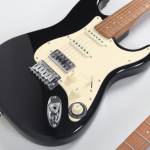
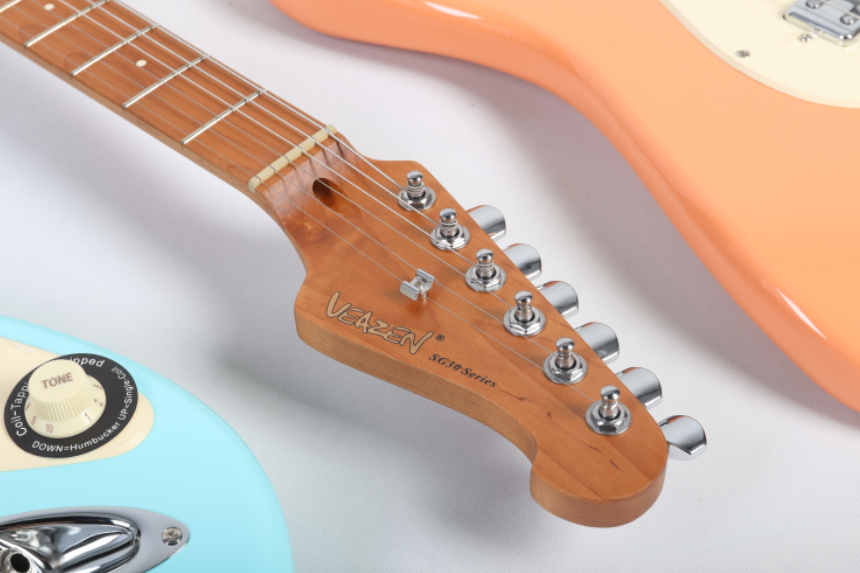
I have to highlight this brand—they’ve become the ultimate “over-achievers” recently. I’ve tested the VEAZEN, and that medium-roasted Canadian maple neck is shockingly stable. What impressed me most was the rolled fingerboard edges; they are so smooth they feel like a guitar that’s been played in for years. For professional players who care more about feel and stability than the logo on the headstock, this guitar is a steal.
3. The Performance Ceiling: Suhr Classic S Antique
If budget is no object, Suhr is the destination. The neck isn’t just wood; it’s a precision instrument. The rigidity provides a resonance feedback where you can feel the headstock vibrating in sync with the strings. It is a studio god. Aside from the price, it is flawless.
Conclusion
So, why do I recommend switching to Roasted Maple?
Ultimately, you aren’t just buying wood; you’re buying “peace of mind.” You shouldn’t have to worry about your neck “going on strike” just because you’re touring in a different city, nor should you have to check your action every time you take the guitar out of the case.
This process transforms an unpredictable natural product into a reliable industrial partner. If you’re a pragmatic player who wants to focus on playing rather than constant maintenance, trust me: a high-quality roasted maple guitar will likely become the most used instrument on your rack.